

Between 30% and 40% of food supply in the United States goes to waste each year, according to the USDA, with tremendous impact to the environment from agricultural processes to the disposal of food waste. Because there is a significant impact across the life cycle of the production of food, there is also a corresponding strategy at every stage, from the production of food through to distribution and into disposal, that can help combat this challenge.
The food waste hierarchy pyramid is an ideal framework for addressing this problem. By applying this framework to your corporate sustainability plans, organizations can make a tremendous impact on reducing food waste and its impact on climate change.
What is the food waste hierarchy?
The waste hierarchy pyramid was borne out of the European Union’s 2008 waste framework directive. The visual tool can be used to evaluate sustainability processes to determine which has the greatest impact.
While corporations with a sustainability focus might approach energy efficiency projects by first tackling the low hanging fruit, the reduction of waste requires a different approach. In this case, it’s best to begin by tackling the most impactful actions first and then address ways to further mitigate any remaining waste.
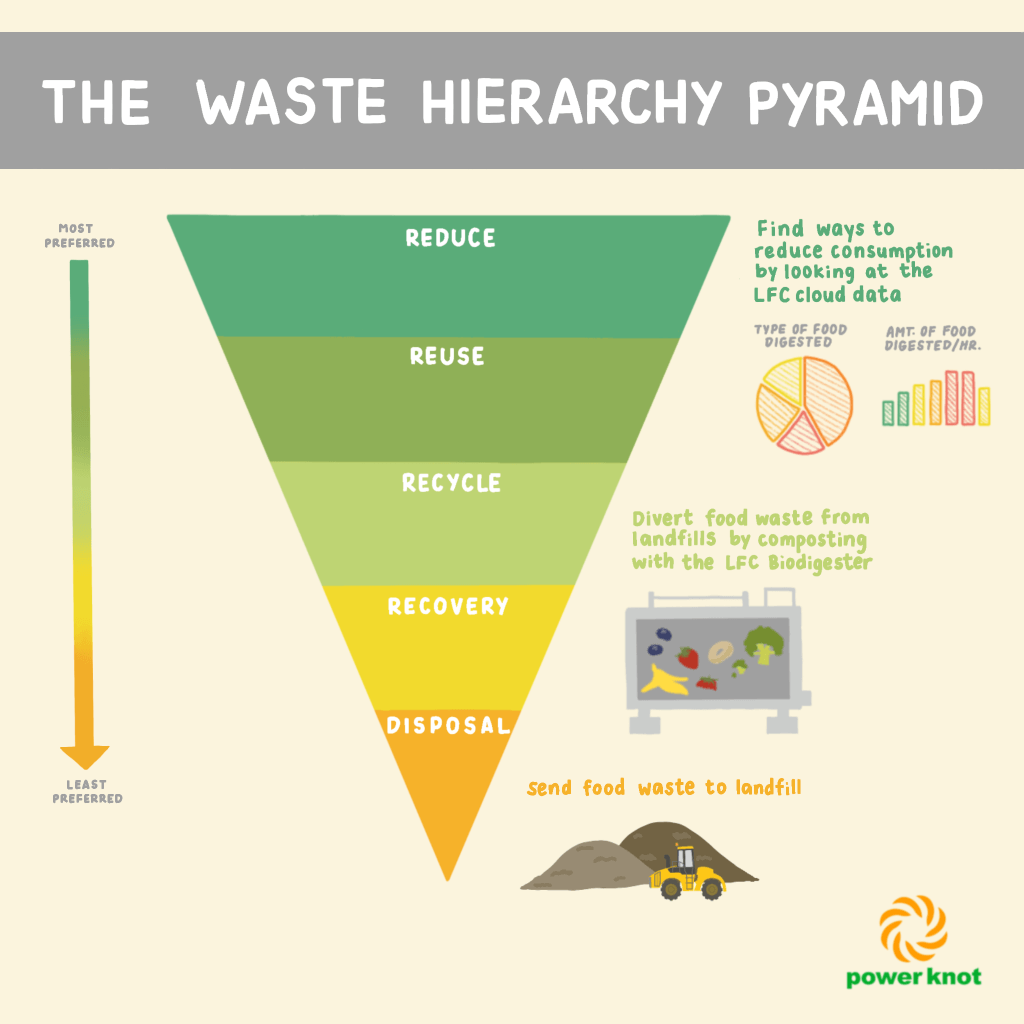
The food waste hierarchy explained
The steps of the food waste hierarchy, from the order of least impactful to most preferred, include the following:
Disposal
Disposal is by far the easiest solution for managing excess waste, but it’s also the solution with the greatest environmental impact. The Environmental Protection Agency reports that food is the single largest category of material sent to U.S. municipal landfills. There, food degrades through an anaerobic (lacking oxygen) process, which produces methane gas. Methane is 87 times worse for the atmosphere than carbon dioxide making it one of the most impactful contributors to climate change. Because municipal solid waste landfills are the third-largest source of human-related methane emissions in the United States, accounting for approximately 14% of these emissions as of 2017, keeping food waste out of the landfill can have a major impact on reducing greenhouse gas emissions.
Recovery
Some landfills and larger producers of food and other agricultural waste are working to recover and use the methane emitted during anaerobic digestion. Anaerobic digesters are large commercial facilities that break down organic material to produce methane that is then burned to produce electricity and heat.
The U.S. Energy Information Administration estimates that in 2019 about 336 U.S. landfills collected this methane gas, burning this biogas to generate about 10.5 billion kWh of electricity, approximately 0.3% of the total U.S. electricity generation. These systems are expensive to set up which is why they are used only at a small number of the nation’s more than 2,000 landfills. The captured methane has less of an impact on the environment than if it was allowed to escape to the atmosphere, but there remain some disadvantages to this form of biogas recovery. The main disadvantage is that combustion of this biogas into usable heat or electricity generates additional air pollutants.
Recycle
Rather than capturing the emissions generated by decomposing food waste, recycling makes use of the food waste itself. Composting is a popular method of diverting food waste from landfills, as it’s relatively simple. However, organizations without the outdoor space for composting, or that cannot justify the cost of removing food waste to a composting facility, find that they can also compost using an onsite aerobic biodigester.
With a biodigester, food waste is aerobically digested by microorganisms to become grey water. Because the process uses oxygen to decompose food, there is no emission of damaging methane gases. Once the grey water is filtered, this environmentally friendly byproduct can be used in the garden and to enrich the landscape.
Reuse
Much of the food that is thrown away today is the result of over-large portion sizes or an inability to accurately gauge the amount of food that is needed. As a result, commercial food operations from grocery retailers to schools and healthcare facilities to restaurants are putting programs in place to donate leftover food. In addition, organizations like Feeding America have rescued around 4 billion pounds of food each year. While this may represent only a small percentage of food that could be donated, it’s making a major impact in helping feed the hungry in addition to lessening the environmental damage caused by food waste.
Reduce
Reducing food waste is by far the most preferred and environmentally friendly way to combat the challenge of food waste, and yet the most difficult. However, much of this difficulty comes from the fact that few organizations have insight into exactly how much waste they’re likely to create on a given day.
Fortunately, with the advent of cloud computing, it has become easier for a wide range of industry sectors to glean accurate insight into their food waste. For example, many organizations are finding that they can use the analytics that come with an onsite biodigester to identify key areas of the waste stream and adjust operations to reduce food waste. The LFC Cloud, for example, provides data on how much food waste is consumed by the biodigester on an hourly basis. It also provides a breakdown of the type of waste being digested. This valuable insight can help food-related organizations make adjustments to what they serve, better gauge inventory levels, and more easily predict demand.
An integrated approach to the food waste problem
For many organizations, some amount of food waste is virtually guaranteed. For example, aged care facilities make a practice of cooking more food than needed to ensure that residents have access to something that will meet their unique dietary needs on a given day. This is where strategies beyond reduction come into play. The key here is to have an integrated strategy for addressing food waste across its life cycle. When one strategy cannot be applied, another goes into action.
Of course, making each step convenient for all stakeholders in their commitment to reduce food waste commitment will also boost the success rate of every action. Perhaps nothing is easier to implement than an LFC biodigester. These fully automatic machines dispose of most food matter cleanly and hygienically within 24 hours and provide a rapid ROI by reducing operational costs.
If you’re ready to take the next step in your commitment to reduce food waste, contact Power Knot today.