

Over the last decade, a range of state and federal agencies have taken action to reduce the tremendous amount of food waste sent to landfills. These actions aim to curb the impact of food waste on climate change; when this organic waste decomposes in landfills, it releases methane, a greenhouse gas 87 times more potent than carbon dioxide. With up to 40% of the U.S. food supply going to waste – and organic waste making up the majority of landfill material – any reduction in food waste stands to have a big impact.
Strategies to curb food waste have ranged widely, from education on the environmental impacts of food waste to regulations that ban the disposal of certain organic waste in landfills. However, new research indicates that statewide food waste bans have been largely ineffective. Fortunately, one state stands out against this claim, and provides some evidence as to how to more effectively reduce food waste going forward.
Food waste regulations demonstrate limited impact
Since 2014, nine states have banned commercial food suppliers from sending food waste to landfills: California, Connecticut, Maryland, Massachusetts, New Jersey, New York, Rhode Island, Vermont, and Washington. Several municipalities – including Portland Oregon, Austin Texas, and Boulder Colorado – have implemented their own local bans as well.
In large part, these bans first focused on requiring large commercial food producers to either compost or donate their food waste. State leaders expected a 10% to 15% waste reduction as a result of these regulations.
However, researchers with The University of Texas at Austin and University of California, San Diego, have compiled data from the first five states to enact food waste bans (California, Connecticut, Rhode Island, Vermont, and Massachusetts) and come to a startling conclusion. According to their analysis, published in Sept. 2024 in Science, laws implemented in four of these five states have been largely ineffective.
The researchers were unable to measure food waste directly, as there is no data available for state levels of food diverted or sent to landfills. Instead, they examined total waste across 36 U.S. states between 1996 and 2019. up a significant amount of overall waste in landfills, states with bans in place would have lower levels of total landfill waste.
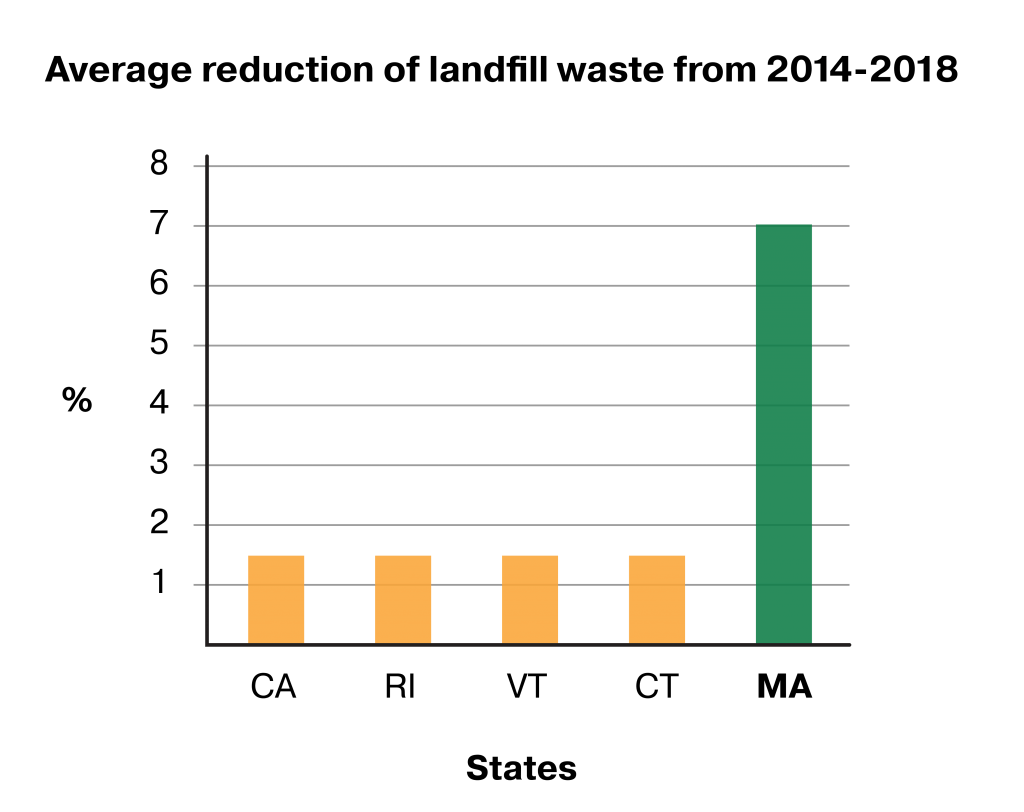
Yet an analysis of available data revealed virtually no difference in waste disposal levels in states with bans as compared to control states without bans – except in Massachusetts.
The researchers tracked an average 1.5% reduction in landfill waste between 2014 and 2018 in the five states with food waste regulations. Massachusetts stood apart for achieving a 7% reduction on average over five years.
What makes Massachusetts’ food waste regulation different
The researchers behind this Science article didn’t just examine the impact of states’ varying food waste regulations. They also dug into what might have contributed to Massachusetts’ success.
In 2014, the Massachusetts Department of Environmental Protection (MassDEP) implemented a ban on the disposal of commercial organic waste in landfills. Organizations are instead encouraged to compost, convert, recycle or reuse food waste. The ban initially applied to organizations that generate one or more tons of organic materials each week, including food processors and distributors, grocery stores, institutional food service providers, and some restaurants. In November 2022, that threshold was expanded to impact commercial organizations producing a half-ton (450 kg) or more of organic waste each week.
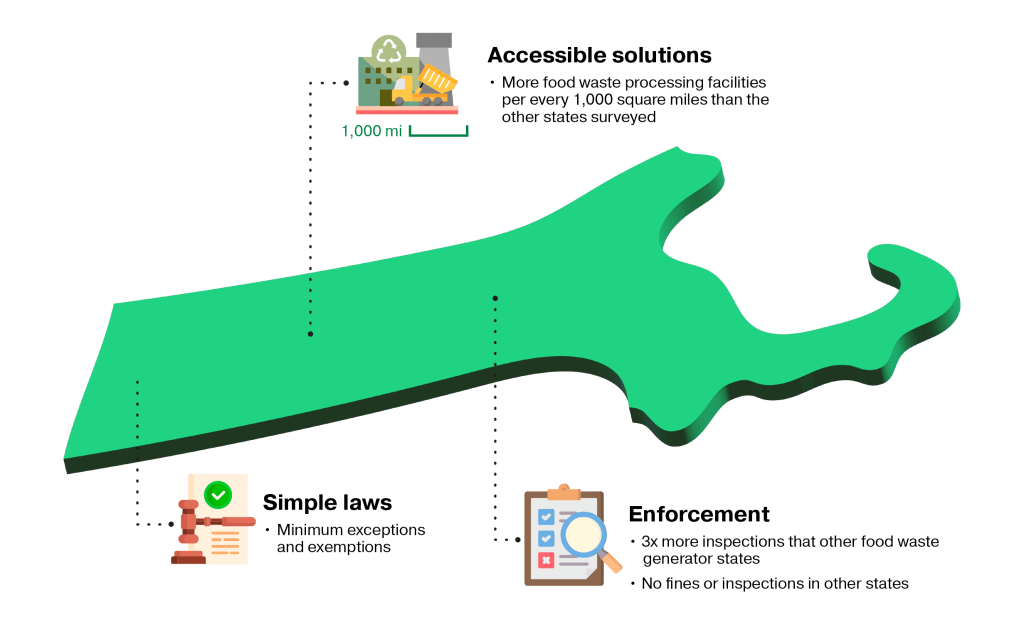
The researchers concluded that Massachusetts was able to effectively reduce food waste by making it easy for businesses and individuals alike to comply with regulations. Specifically, three key elements of its approach to the disposal of food waste stand out:
Accessibility: The state has more food waste processing facilities per every 1,000 square miles than the other states surveyed. Officials work to connect regulated organizations with on-site and off-site alternatives for processing food waste. Other states, including Connecticut, have been plagued by a lack of funding for investments in additional infrastructure to manage waste.

Simplicity: The law in Massachusetts is reportedly straightforward and easy to understand. Compared to other states, it offers minimal exceptions and exemptions. This conclusion was further upheld by research that found a quarter of all Vermonters report finding their state’s food waste ban to be confusing.

Enforcement: Massachusetts had more than three times the number of inspections per food waste generator each year than the next closest state, Vermont. The researchers found virtually no enforcement – either inspections or fines – in the other states surveyed.
How to make progress in reducing food waste
As Fiorentia Anglou, a coauthor who contributed to the research while earning a PhD at the University of Texas at Austin’s McCombs School of Business, commented in the UC San Diego article, “With food waste around the globe contributing 8% to 10% of greenhouse gas emissions, we certainly don’t think states should abandon these laws, but more action needs to be taken to make them effective.”
In fact, action is already underway to make state food waste regulations more impactful. The researchers were only able to examine data collected through 2019, but since that time a number of states have made their regulations more stringent. For example, California began providing all residents and businesses with organic waste collection services in 2022 in order to simplify compliance for everyone.
How a food waste biodigester can help
As this research highlights, accessibility and simplicity are essential for ensuring compliance with food waste bans. It’s these two factors that prompt many organizations to adopt on-site biodigesters.
By installing this sealed equipment directly in the food preparation area, food processors of all types and sizes can effectively divert food waste from landfills. This automatic food waste digester is capable of breaking down a wide range of organic materials without generating the damaging methane emitted by food left to decompose in the landfill. In addition to making compliance with food waste regulations easy, many organizations find they see a return on their investment within three years.
Whether you’re looking for an easier way to meet your state’s regulations, or proactively taking action to reduce your environmental impact, an LFC biodigester can help. Take control of your food waste today.