


Jan De Nul Group, a global leader in Offshore Energy, Dredging, Construction, and Planet Redevelopment, is bringing onshore sustainability standards to one of the largest crane vessels in its fleet with the LFC biodigester.
Jan De Nul Group has placed sustainability at the center of its story, positioning itself as a solutions provider for challenges such as the transition to renewable energy, soil and water pollution, and coastline protection. That commitment now extends below deck, to a problem that has quietly challenged crews at sea for decades: what to do with food waste on vessels that stay offshore for months at a time.
The Challenge: Feeding a Full-Time Crew, Far From Shore
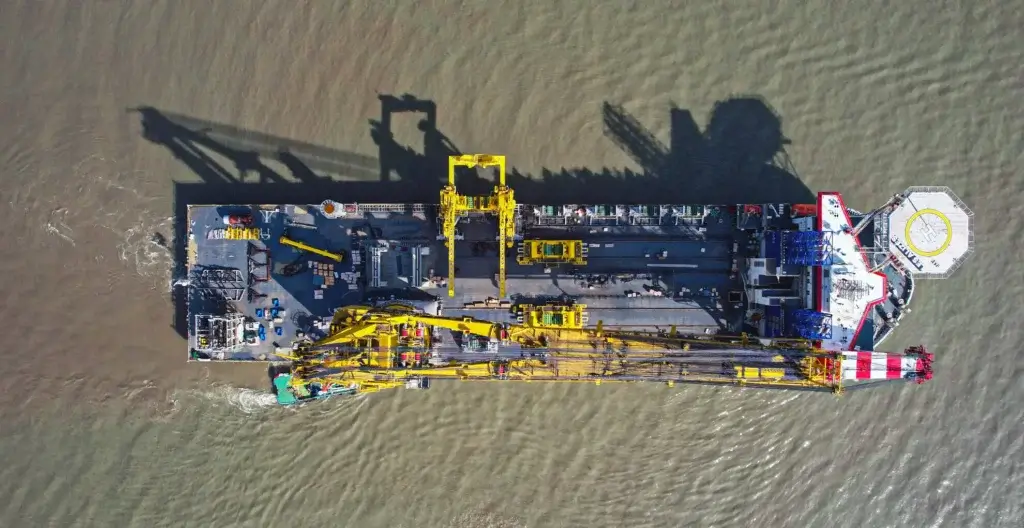
Wind turbines have only gotten bigger in recent years, and installing them requires increasingly larger vessels. Jan De Nul’s Les Alizés vessel was built to meet that demand. With a 5,000-tonne crane, 61,000-tonne dead weight capacity and 9,300 m² of deck space, she is able to load out, transport and install multiple units of the largest and heaviest wind turbine foundations while floating, and is equally capable of decommissioning offshore oil and gas platforms.
Les Alizés is one of the first vessels in the world able to install this newest generation of wind turbines, and the first vessel of her dimensions in Jan De Nul’s fleet. That scale comes with a tradeoff: large-scale offshore wind and decommissioning projects keep her at sea for long stretches with a full-time crew aboard, and every meal served onboard generates food waste that traditionally must be stored until the next port call.
The Solution: LFC Biodigester Built for Life at Sea
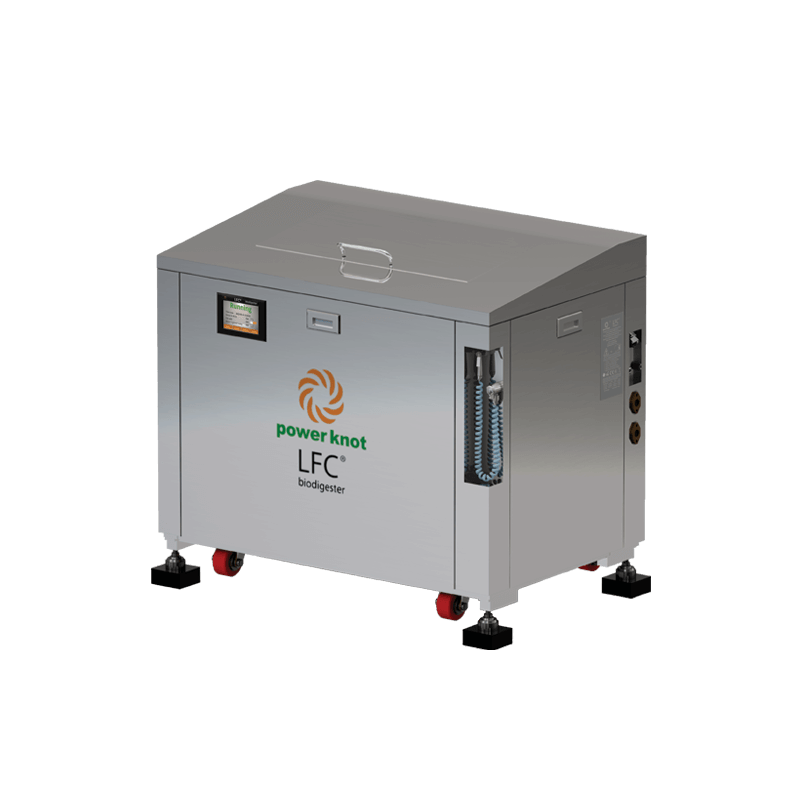
To eliminate the need to store food waste onboard, Power Knot Ocean installed an LFC-100 biodigester aboard Les Alizés. The fully enclosed, automatic system digests up to 100 kg (220 lb) of food waste every day using naturally occurring microorganisms. Rather than allowing waste to accumulate in refrigerated bins or storage rooms, the LFC biodigester continuously converts food waste into environmentally safe grey water, helping maintain a cleaner, more hygienic galley while reducing odors, storage requirements, and the need to offload waste in port.
Since coming online at the end of March 2026, the biodigester has processed more than 7,500 kg of food waste in under four months, quietly running in the background of one of the busiest galleys in Jan De Nul’s fleet.
For the ship’s cook, the results have been hard to miss.
“It’s like feeding a pig that never gets full,” says the vessel’s cook, who has embraced the biodigester as part of the daily kitchen routine.
A Standard for the Rest of the Fleet
The results aboard Les Alizés have convinced Jan De Nul Group to make the LFC biodigester a standard fixture going forward: the company will install LFC biodigesters on all of its new-build vessels from here on.
As Jan De Nul Group continues to expand its offshore wind and dredging operations into some of the most demanding marine environments in the world, onboard food waste management is becoming as much a part of the build specification as the crane on deck, proof that sustainability commitments made onshore can hold up just as well hundreds of miles out to sea.