

By Iain Milnes
In-sink garbage disposal or landfill; which is the best approach? It depends who you ask. A 2011 study conducted by Life Cycle Assessment (and commissioned by InSinkErator, a manufacturer of food waste disposers) found that putting food scraps into a kitchen garbage disposer resulted in lower global warming potential than putting it in the trash destined for the landfill. It’s certainly true that sending any organic waste to the landfill is to be avoided at all costs because it decomposes anaerobically, resulting in excess methane.
More recent analyses indicate that the calculus regarding in-sink garbage disposal of food waste is not so simple. A March 2019 article by the Associated Press reported that wastewater and environment experts agree that the environmental value of kitchen disposal systems depends on the wastewater system of a given locality. Disposals make sense if your wastewater system is set up to convert food waste into energy, as is the case in a growing number of big cities. The report goes on to note that, Disposals also might not be the best option in areas with water shortages: conveying food waste through pipes and treating it at a plant can be energy- and water-intensive.
Many cities are actively discouraging homeowners from using in-sink waste food disposal; they urge residents to include food waste such as scraps and leftovers in the same green bin as yard waste. But offering a waste food recycling program to multi-family residential buildings and commercial foodservice operators requires a different approach- and here’s where local regulations and ordinances become important.
Many cities and states have signed into law regulations that require businesses to separate organic waste from other trash so that it can be diverted to a centralized processing facility. Here in California, that typically means a local composting facility. In your city, it may be different. For example, in Connecticut there are cities that work with anaerobic digestion plants. For these commercial customers, some important financial and operational considerations emerge:
- The cost of food waste pickups can be significant- especially with larger volumes of food waste since daily pickups are required.
- Storing waste food between pickups is messy and smelly while encouraging pests and vermin.
- Haulage of this waste to a distant central facility means yet another truck on the road.
To lower the rising costs food waste pickup, some businesses are opting to process it onsite using a biodigester. Unlike a classic in-sink garbage disposal unit, which macerates the waste food into small chunks, a food biodigester does not send biosolids into the sewer. This process, which differs from energy-intensive waste food desiccation, employs an aerobic decomposition process that converts the waste food into gray water suitable for output to the sewer.
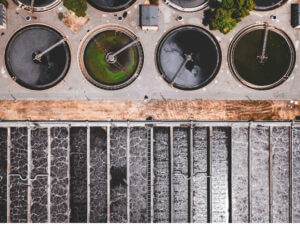
Still, some wastewater treatment operators are concerned about how these biodigesters will affect the municipal wastewater infrastructure. Will their output clog sewers or significantly boost the level of organic waste at the wastewater treatment plant?
In fact, waste food biodigesters coexist well with typical municipal wastewater systems. Since a biodigester uses microorganisms to digest food scraps (including fats), its output does not contain the chunks of food waste generated by maceration. A screen between the unit and the sewer discharge pipe ensures only digested material flows through. The amount of undigested organic material able to pass through the screen without being digested is small; from a load of 1,200 pounds of food waste, the quantity of organic waste discharged to sewer is less than the amount of organics in two defecations. This is well within the guidelines of most every wastewater treatment plant’s guidelines for permitted volumes commercial organic waste in the sewer.
Another question that arises: what about the micro-organisms remaining in the digestate-infused water? Will they interfere with the aerobic decomposition processes the sewage treatment plant? In reality, most die due to lack of food before they arrive at the wastewater treatment plant.
If you’re a restaurant or facilities manager managing big invoices for your waste food pickup, it’s time to evaluate how onsite processing can eliminate that cost and reduce your carbon footprint. Our wide range of versatile LFC® biodigesters means there’s a machine that will handle your volume of waste food while providing positive cash flow within 18 months.