

Vacuum maceration and holding systems are commonly used in commercial kitchens, hospitals, cruise ships, and other facilities that generate large volumes of food waste. Rather than treating or disposing of food waste on-site, these systems collect, grind, and transport it to a centralized holding tank until it can be hauled away.
Like every food waste management technology, vacuum maceration and holding systems have advantages and limitations. Understanding how they work can help determine whether they are the right solution for your facility.
What is a vacuum maceration and holding system?
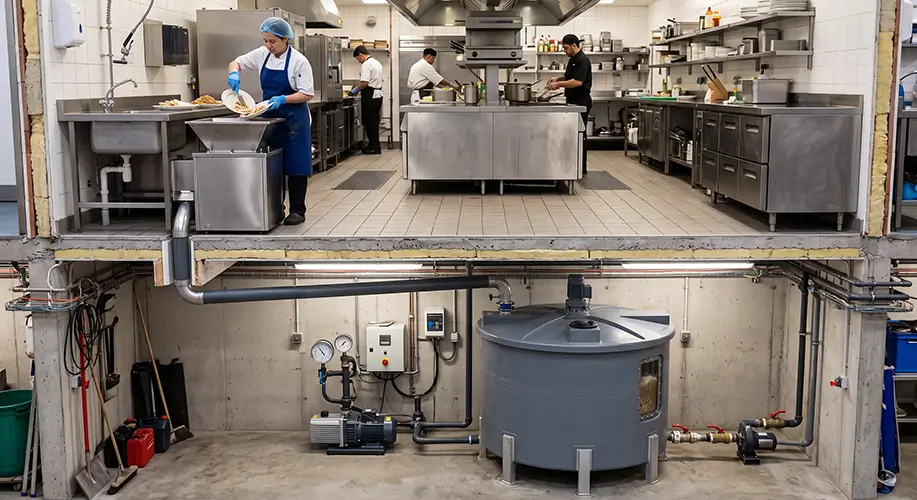
A vacuum maceration and holding system uses vacuum pressure to transport food waste through a network of pipes after it has been ground into a slurry. The waste is collected in a sealed holding tank, where it remains until it is pumped into a tanker truck for off-site treatment, composting, anaerobic digestion, or disposal.
Unlike food waste digesters, vacuum maceration systems do not treat or reduce the amount of food waste. Instead, they provide an efficient method for collecting and storing waste until it is removed from the facility.
Does it reduce food waste?
No.
Vacuum maceration systems do not digest, compost, or dehydrate food waste. The waste remains intact after grinding, although it has been reduced to smaller particles and mixed with water to create a pumpable slurry.
The same amount of organic material ultimately leaves the facility, typically through scheduled waste collection.
How does a vacuum maceration and holding system work?
Most systems operate continuously throughout the day.
Stage 1: Waste Collection
Food waste is deposited into collection stations located throughout the facility.
Why it matters
Multiple collection points allow staff to dispose of food waste without transporting heavy bins through the building.
Stage 2: Maceration
A grinder or macerator breaks the food waste into smaller particles while water is added to create a slurry.
Why it matters
Reducing particle size allows the waste to move efficiently through the vacuum piping system.
Stage 3: Vacuum Transport
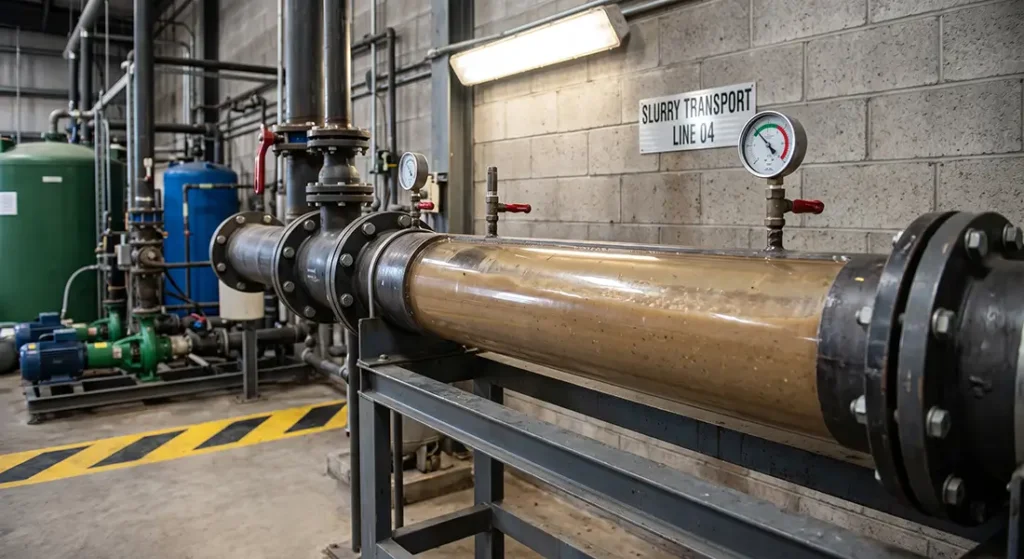
A vacuum moves the slurry through sealed piping to a central holding tank.
Why it matters
The enclosed system minimizes manual handling and can transport food waste over long distances within a facility.
Stage 4: Storage
The slurry is stored in a holding tank until it is collected by a waste hauler.
Why it matters
Centralized storage reduces the need for multiple waste containers throughout the facility.
How much space does it require?
The collection stations occupy relatively little space, but the system requires underground or overhead piping, a vacuum unit, and one or more holding tanks. Larger facilities may require substantial plant room space for the supporting equipment.
How much does it cost to operate?
Operating costs include electricity for grinders, pumps, and vacuum equipment, water used to create the slurry, routine maintenance, and scheduled waste hauling.
Because the food waste remains on-site until collection, facilities continue to pay for transporting and processing the organic waste after it leaves the property.
Who should use a vacuum maceration and holding system?
Vacuum maceration systems may be suitable for facilities that:
- Generate large volumes of food waste from multiple locations
- Need to transport waste over long distances within a building
- Want to reduce manual handling of heavy waste bins
- Have centralized waste collection infrastructure
- Already have regular waste hauling services
Benefits and Drawbacks of Vacuum Maceration & Holding Systems for Food Waste
| Benefits | Drawbacks |
|---|---|
| Reduces manual handling of food waste | Does not reduce the amount of food waste generated |
| Multiple disposal stations improve operational efficiency | Food waste still requires off-site hauling and disposal |
| Enclosed piping helps contain odors during transport | Uses water to create a transportable slurry |
| Centralized waste collection simplifies facility operations | Requires specialized piping, vacuum equipment, and holding tanks |
| May fulfill MARPOL regulations regarding food waste on ships | Installation costs can be significant, particularly in existing buildings |
| High maintenance costs for maceration blade replacement and vacuum equipment |
Alternative Food Waste Solutions
Vacuum maceration systems simplify the collection and transport of food waste but do not eliminate the need for hauling or off-site processing.
For organizations looking to treat food waste on-site, the Power Knot LFC biodigester uses naturally occurring microorganisms to continuously digest food waste, converting it into grey water that can safely enter the sewer system where permitted by local regulations. This offers a complete solution that eliminates the need to hold, transport, and remove waste.