

Ask most commercial kitchen managers to name their top safety priorities, and they will list knife handling, burn prevention, and slip-and-fall hazards. Rarely does manual lifting make the list. Yet according to the Bureau of Labor Statistics, more than one million workers in the United States suffer back injuries each year, with three quarters of those injuries occurring during lifting tasks. In full-service restaurants alone, nearly 94,000 nonfatal injuries and illnesses are reported annually.
Manual lifting is not a minor hazard. In a commercial kitchen, it is a daily, repetitive, and often overlooked risk, and one of the most preventable.
The Lifting Problem in Commercial Kitchens

Waste handling is a physical constant in any food preparation environment. Bins fill throughout the day during prep, service, and clean-up. In high-volume operations, a single bin can reach weights of 35 kg (75 lb) or more by the time it needs to be emptied. Staff lift and carry these bins repeatedly, often in tight spaces, while twisting, bending, or reaching to clear countertops and worktables.
None of these conditions is unusual. Each of them increases the risk of injury. The NIOSH Lifting Equation, which OSHA recommends as the standard tool for assessing manual lifting hazards, factors in not just the weight of a load but how often it is lifted, how far the worker must reach, whether twisting is involved, and the duration of the working day. A waste bin that might seem manageable in isolation becomes a significant ergonomic hazard when it is lifted a dozen times per shift under suboptimal conditions.
The SBT bin tipper from Power Knot, a leading manufacturer of food waste solutions, is designed to eliminate this hazard entirely. The SBT bin tipper is a battery-powered, stainless steel machine that lifts, tilts, and empties bins automatically, removing the need for manual lifting at the point of waste disposal.
What OSHA Requires, and What It Recommends
OSHA does not currently have a specific standard for weight limits for an employee to lift items. However, this does not mean employers are without obligation. Under Section 5(a)(1) of the OSH Act, commonly known as the General Duty Clause, employers are required to provide a workplace free from recognized hazards that are causing or likely to cause serious physical harm. Manual lifting of heavy bins, performed repeatedly throughout a shift, meets the standard of a recognized ergonomic hazard.
OSHA consistently directs employers to the NIOSH Lifting Equation as the appropriate framework for evaluating lifting hazards. Where the Lifting Index exceeds 1.0 for any task, OSHA guidance is clear: provide workers with material handling equipment to keep them safe. For facility directors and general managers building a defensible safety program, this means that repeatedly assigning staff to lift heavy waste bins without mechanical assistance is not a neutral decision. It is an identifiable and addressable risk.
OSHA also identifies engineering controls as the preferred solution for ergonomic hazards, ranking them above administrative controls such as rotation schedules or training. A bin tipper is exactly the kind of engineering control OSHA recommends: it removes the hazard at the source rather than managing exposure to it.
The True Cost of a Lifting Injury
The case for bin tippers is not just about compliance. It is also financial. The AmTrust 2024 Restaurant Risk Report, which analyzed nearly 130,000 workers compensation claims across the restaurant industry from 2018 to 2023, found that muscle strains and back injuries are among the most expensive claims an employer can face.
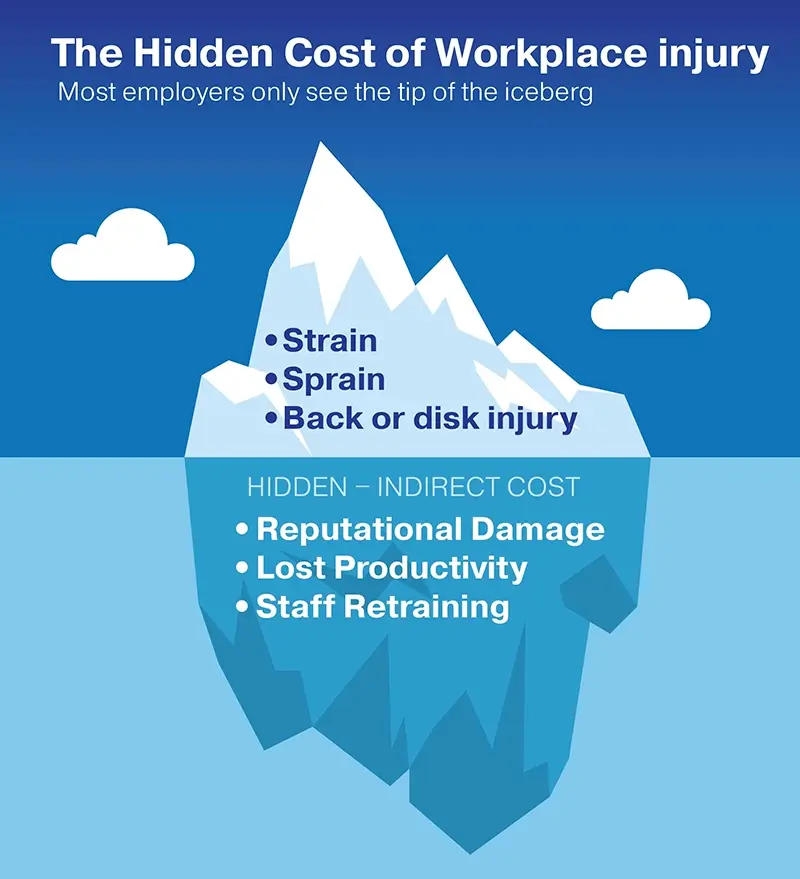
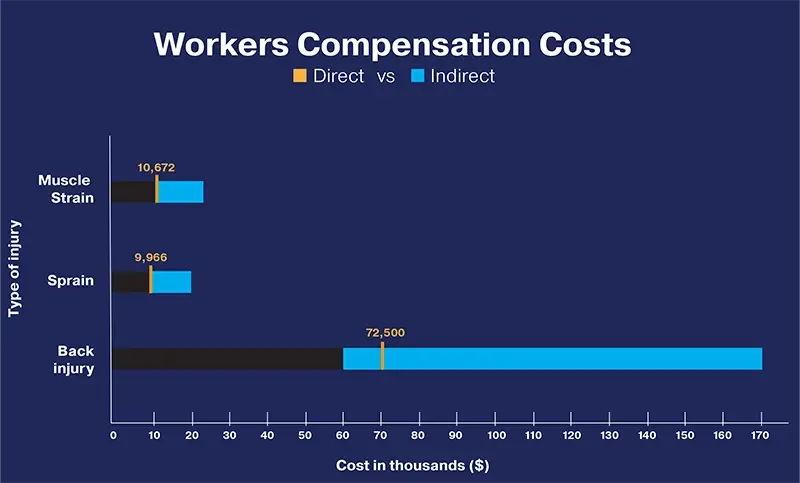
Strain claims average $10,672 per incident. Sprain claims average $9,966. Back injuries involving discs, vertebrae, or spinal cord damage average between $60,000 and $85,000 per claim. These figures cover direct medical costs only. OSHA notes that indirect costs, including lost productivity, temporary labor, staff replacement and retraining, and reputational damage, can be one to twenty times greater than the direct costs of the injury.
Strain claims average $10,672 per incident. Sprain claims average $9,966. Back injuries involving discs, vertebrae, or spinal cord damage average between $60,000 and $85,000 per claim. These figures cover direct medical costs only. OSHA notes that indirect costs, including lost productivity, temporary labor, staff replacement and retraining, and reputational damage, can be one to twenty times greater than the direct costs of the injury.
A single serious back injury in a commercial kitchen can cost far more than the price of the equipment that would have prevented it. Viewed through this lens, a bin tipper is not an operational expense. It is a risk management investment with a calculable return.
Built for the Commercial Kitchen Environment
Power Knot designed the SBT-140 bin tipper with kitchen environments in mind, where hygiene, durability, and ease of use are mandatory. The machine is constructed entirely from stainless steel, which resists corrosion, tolerates sanitizing chemicals, and meets the cleanliness standards required in food preparation areas. It is battery-powered, which eliminates trip hazards from power cables and allows the machine to be moved wherever it is needed. It fits through standard doorways, making it practical in the tight corridors of most commercial kitchen layouts.
Safety features are built in as standard. The SBT bin tipper requires both hands to operate, ensuring that the operator cannot have an arm near moving parts during the tipping cycle. A high-visibility emergency stop button is prominently positioned for immediate access. These are not optional extras. They are requirements that Power Knot has incorporated as a result of rigorous research and development and direct feedback from customers operating in real-world kitchen environments.
For operations handling larger bins, the SBT-360 bin tipper handles bins from 90 to 360 litres (24 to 96 gallons) and lifts loads up to 140 kg (300 lb). It can also tip contents into gaylord containers of varying heights, making it suitable for operations beyond the kitchen, including data destruction, manufacturing, and waste compaction facilities.
Adding the SBT Bin Tipper to Equipment Lineup
A kitchen safety plan that addresses cuts, burns, and slips but does not account for manual lifting is incomplete. Ergonomic hazards associated with waste handling are documented, measurable, and preventable. Including mechanical lift-assist equipment in your safety framework is both an OSHA-recommended practice and a straightforward way to reduce your organization’s injury exposure.
Practically, this means assessing the weight and frequency of bin lifting in your operation, identifying the highest-risk tasks and locations, and specifying a bin tipper that matches your bin size, layout, and usage patterns. Power Knot’s team can assist with this assessment and help identify the right SBT bin tipper model for your facility.
Contact Power Knot today to see if the SBT bin tipper is right for your facility.