

Moving food waste from the kitchen to its final destination may seem like a simple task, but it is one of the most overlooked parts of commercial kitchen operations. Every day, staff transport hundreds of pounds of food waste through busy corridors, around customers, and between preparation areas. Without the right equipment and procedures, this routine task can lead to spills, employee injuries, cross-contamination, and unnecessary labor.
Whether your facility is a hotel, hospital, university, cruise ship, airline catering facility, or food manufacturing plant, improving the transportation of food waste is an easy way to make your operation safer, cleaner, and more efficient.
Why food waste transport matters
Commercial kitchens invest heavily in food preparation equipment, refrigeration, and sanitation. Yet the process of moving food waste is often handled with whatever carts or containers happen to be available.
Poor commercial kitchen waste handling creates several challenges:
- Wet floors from leaking containers increase the risk of slips and falls.
- Heavy manual lifting can lead to back, shoulder, and repetitive strain injuries.
- Food waste passing through clean areas increases the risk of cross-contamination.
- Multiple trips between the kitchen and waste processing area reduce staff productivity.
- Damaged or unstable carts increase maintenance costs and equipment downtime.
A well-designed waste handling process helps address each of these issues.
Preventing spills before they happen
Food waste is often wet, heavy, and unevenly distributed. Containers that are difficult to secure or carts that lack proper support can allow bins to shift during transport, resulting in spills that create safety hazards and require immediate cleanup.
Best practices include:
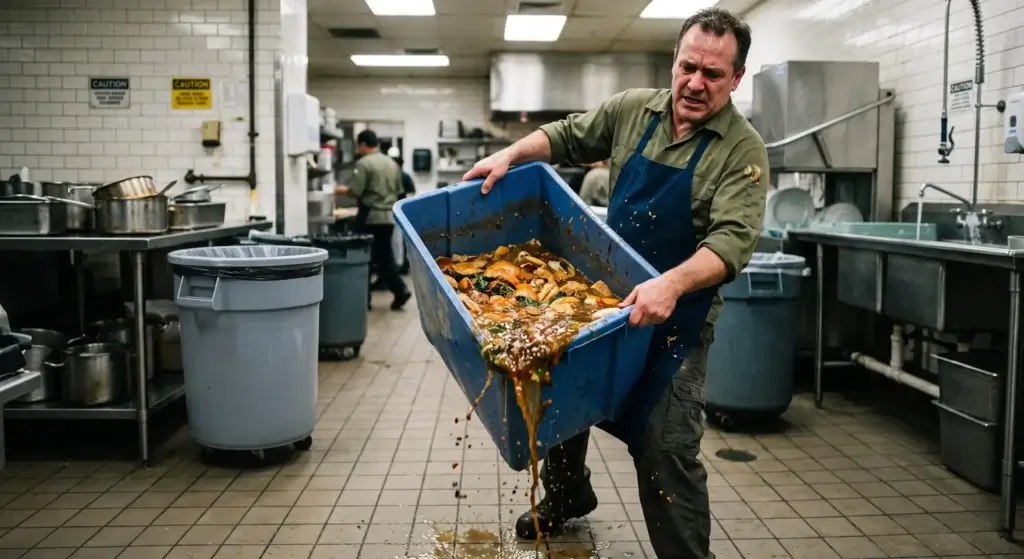
- Using dedicated food waste containers
- Utilizing bus box carts or bus totes for waste handling
- Keeping bins securely supported during transport
- Avoiding overloaded containers
- Selecting carts designed specifically for commercial kitchen environments
- Using lockable wheels whenever the cart is stationary
Preventing even a single spill can save cleanup time while reducing the risk of employee injuries.
Reducing employee injuries
Manual handling remains one of the leading causes of workplace injuries in commercial kitchens. Employees frequently push heavy loads across long distances, through doorways, onto elevators, and around tight corners.
Ergonomically designed equipment can significantly reduce physical strain by allowing staff to move multiple containers safely in a single trip rather than carrying or dragging individual bins.
The goal is not simply moving waste: it is moving waste consistently, safely, and with minimal physical effort.
Protecting food safety
Food waste should always remain separate from food preparation activities. During transport, exposed waste can contaminate surrounding surfaces, equipment, or walkways if spills occur.
Facilities should establish designated waste transport routes whenever possible and use equipment that is easy to clean and sanitize after each use.
Color-coded bins provide another simple but highly effective layer of protection. Designated colored containers allow staff to quickly identify and separate different waste streams, such as food waste, recyclables, and general waste. Clear visual identification reduces sorting errors, supports employee training, and helps facilities maintain consistent waste handling procedures.
Stainless steel is particularly well suited for food waste handling because it resists corrosion, withstands aggressive cleaning chemicals, and maintains a hygienic surface throughout years of daily operation.
Improving workflow efficiency
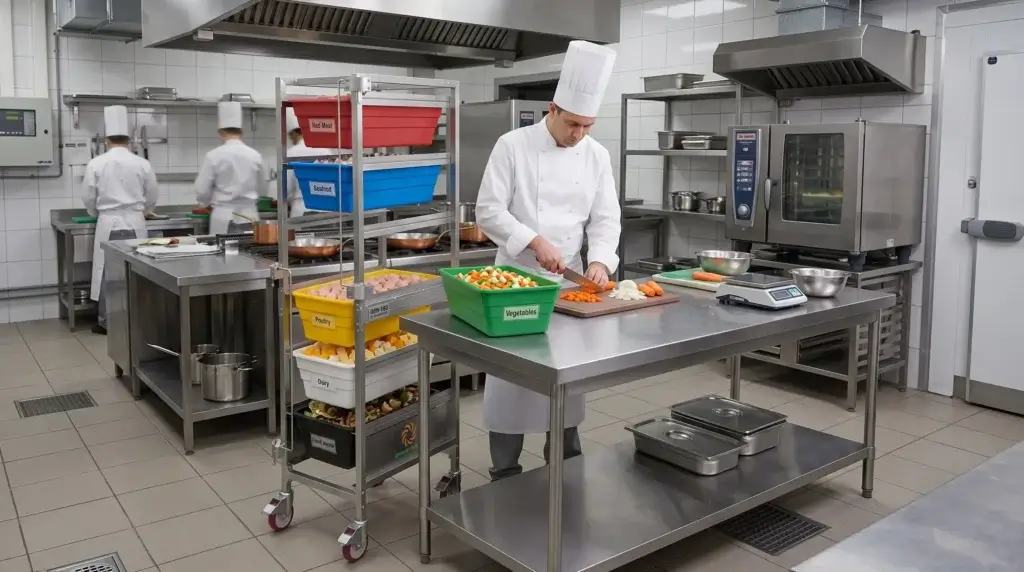
One of the easiest ways to improve kitchen productivity is reducing the number of trips employees make to dispose of food waste.
Instead of moving individual containers throughout the day, facilities can consolidate waste collection into larger batches. This reduces interruptions, shortens transport time, and allows staff to spend more time preparing food and serving customers.
An efficient workflow might look like this:
- Food waste is collected at preparation stations.
- Waste is transferred into dedicated transport bins.
- Multiple bins are transported simultaneously.
- Waste is emptied into a grinder, biodigester, or other processing equipment.
- Clean bins return to the kitchen for reuse.
Optimizing each step helps improve both labor efficiency and workplace safety.
Designed for professional kitchens: the Power Knot SBH lug cart
To simplify food waste transport, Power Knot developed the SBH family of stainless steel lug carts for demanding commercial environments.
The SBH lug carts are available in two configurations:
- SBH-90 lug cart– accommodates three lug bins
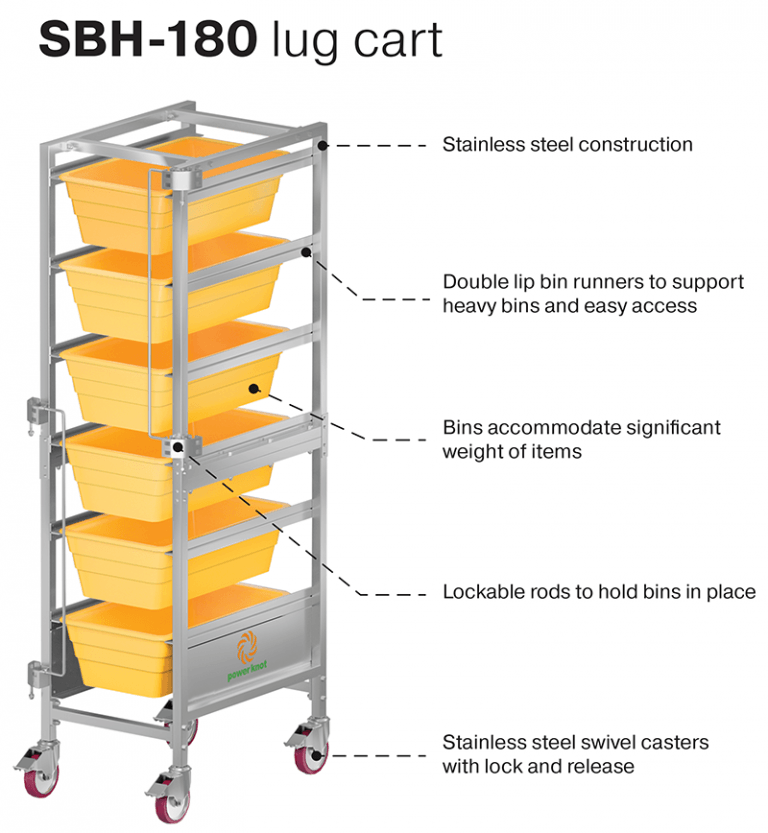
- SBH-180 lug cart– accommodates six lug bins
Both models are constructed entirely from stainless steel for maximum durability and hygiene. Double-lipped bin runners securely support each container during transport, while stop mechanisms prevent bins from sliding out as the cart moves through busy kitchens.
The carts can be loaded from either side, making them easy to use regardless of kitchen layout. Four heavy-duty lockable casters provide stability when stationary while allowing smooth movement between work areas.
Because the carts are designed specifically for commercial kitchens, airline catering facilities, cruise ships, hospitals, hotels, universities, food manufacturing plants, and other demanding environments, they withstand years of daily use while remaining easy to clean and sanitize. Butcher shops and meat processing facilities often call them meat lug carts or meat lugs; hotels and hospitals refer to them as utility bin carts.
One piece of the solution
Transporting food waste is only one step in the waste management process. The greatest efficiencies are achieved when collection, transport, lifting, grinding, and processing are designed to work together.
Power Knot offers a complete range of onsite organic waste management solutions, including:
- SBH lug cart for transporting food waste
- SBT bin tipper for safely lifting and emptying bins
- BCG grinder for reducing food waste particle size
- LFC biodigester for digesting food waste onsite
- GSM Box for connecting the LFC biodigester to the cloud
- LFC Cloud for monitoring system performance and reporting
Designed together, these products create a streamlined workflow that reduces manual labor, improves workplace safety, and helps organizations manage and report food waste more efficiently.
Make food waste transport safer
Improving food waste transport does not require major operational changes. By using equipment designed specifically for commercial kitchen waste handling, organizations can reduce spills, minimize employee injuries, improve sanitation, and create a more efficient workflow.
Whether transporting three bins or six, the Power Knot SBH lug cart provides a durable, hygienic, and reliable solution that helps kitchens move food waste safely every day. Contact Power Knot today to take the first step towards commercial food waste management.