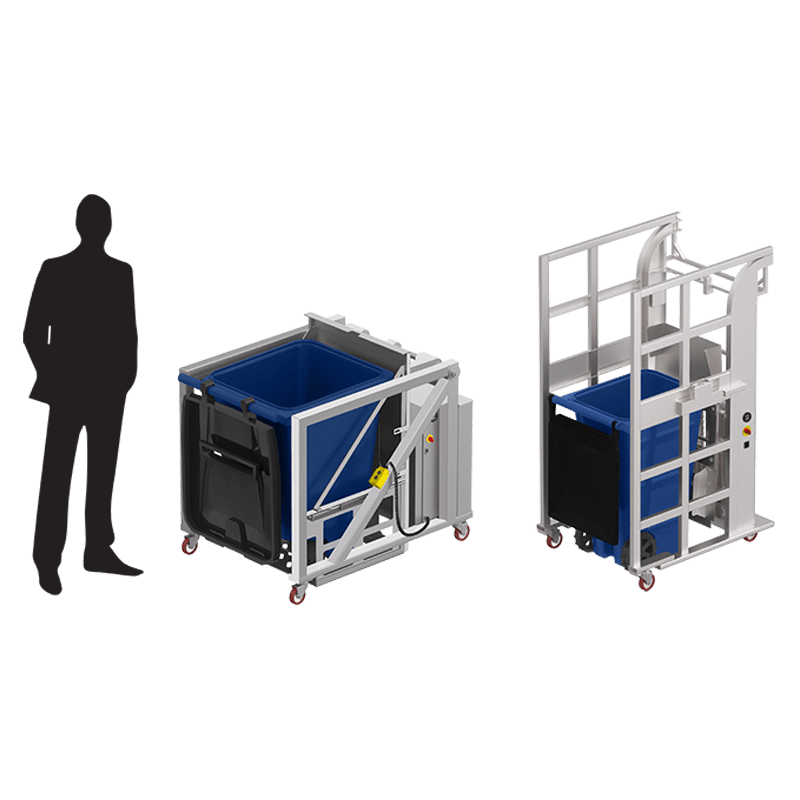

The commercial kitchen is the most common setting for a bin tipper, but far from the only one. Power Knot’s SBT bin tipper range is used across data destruction, pharmaceutical manufacturing, higher education, facility management, and more. What these environments share is a recurring need to empty heavy bins safely and efficiently, without the manual lifting that leads to workplace injury and interruption of the workflow.
Any operation where staff regularly lift bins weighing more than 16 kg (35 lb) is a practical candidate. The following sections cover how different industries are using bin tippers and what drives the fit in each case.
Data Destruction
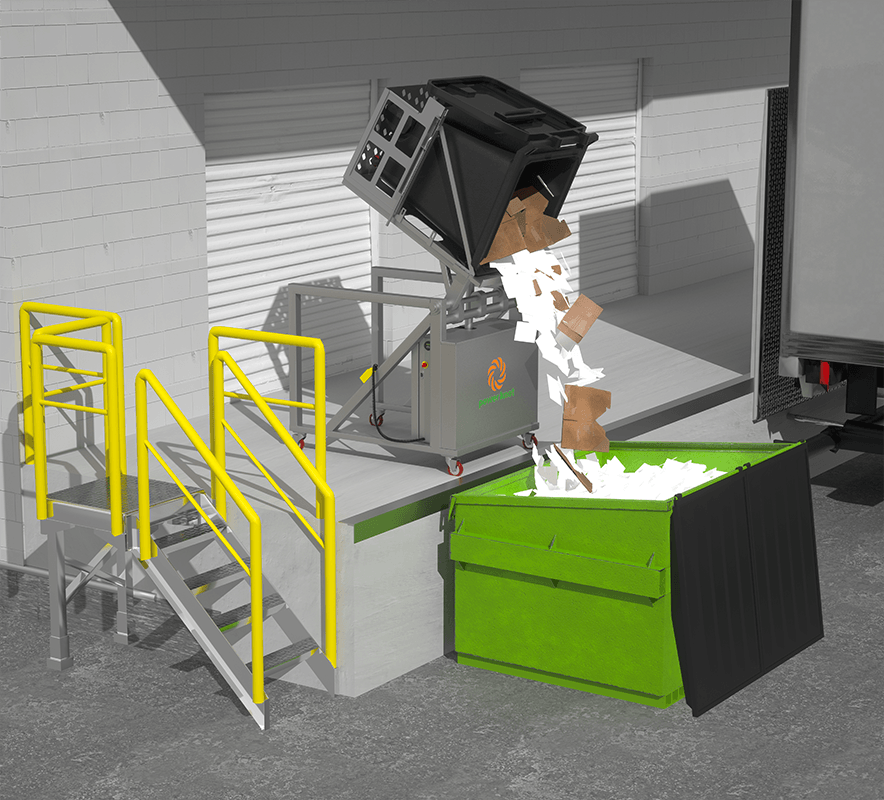
Data destruction companies collect secure bins from client sites, transport them in vehicles, and tip the contents into industrial shredders. The challenge is that shredders are often elevated, trucks have low interior ceilings, and bins can be heavy. Manual tipping in a confined vehicle is both slow and physically demanding.
The SBT-360 bin tipper was developed in part to address this. Its 30-degree tipping angle and maximum extended height of 2.38 m (7.8 ft) are sized to operate within a standard truck interior. It handles bins from 90 to 360 litres (24 to 96 gallons) and loads up to 140 kg (300 lb), completing a full tipping cycle in under 20 seconds. The battery-powered design requires no power connection inside the vehicle.
In Practice: Vital Records Control (VRC), United States
VRC, a national leader in secure information management operating across more than 200 US markets, previously relied on stationary bin tippers from a manufacturer that had discontinued the product. Without spare parts or support, daily operations were at risk and the company could not standardize its equipment fleet. After evaluating alternatives, VRC transitioned to the SBT-360 bin tipper. The machine’s mobility means it can be deployed anywhere in a warehouse or operated inside a truck during field collections.
VRC has since deployed scores of units across its US facilities, and the machine is now one of the first tasks taught to new hires.
Pharmaceutical and Healthcare
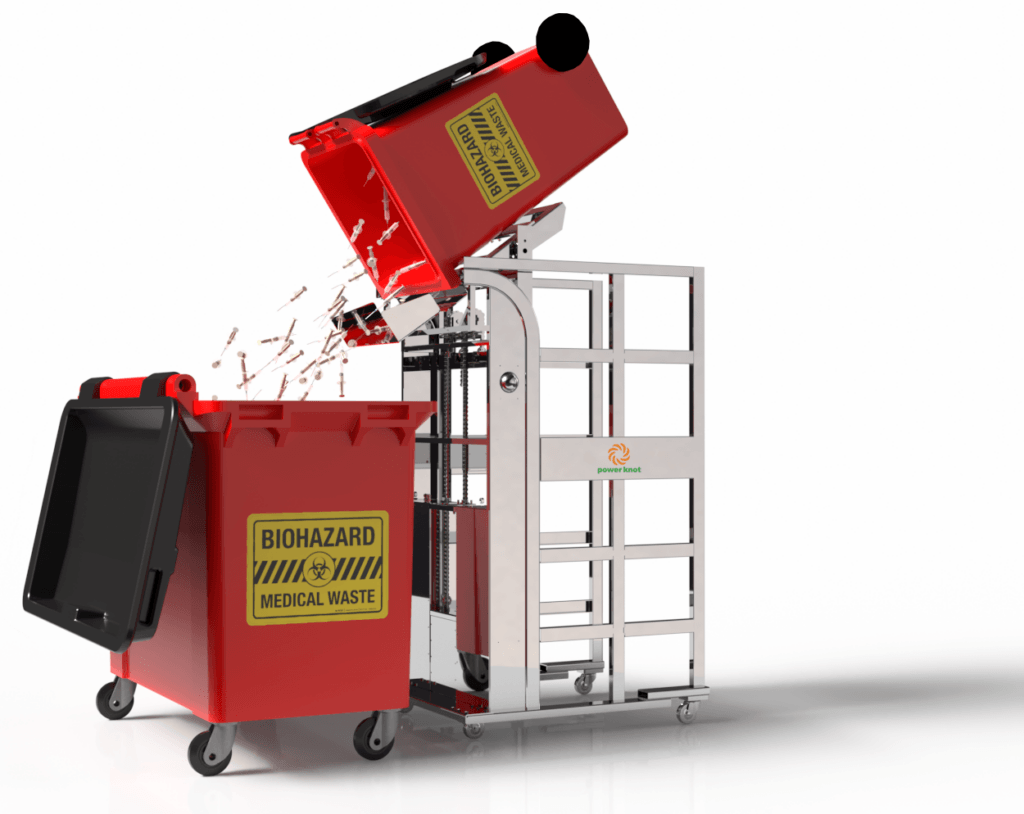
In pharmaceutical manufacturing and healthcare settings, waste handling carries compliance implications beyond simple disposal. Materials may include pharmaceutical residues, biological waste, or controlled substances. Direct staff contact with bin contents introduces both injury risk and contamination risk.
A bin tipper reduces direct contact during the tipping cycle and removes the repetitive lifting that contributes to musculoskeletal injury. The SBT-140 bin tipper’s all-stainless-steel construction, waterproof switches, and hose-down capability are practical for environments with rigorous sanitation routines. The dual-hand operation requirement keeps the operator’s arms clear of the mechanism throughout the lift.
Manufacturing
Production floors accumulate material throughout the day: wood scraps, metal shavings, plastic pellets, offcuts, packaging waste. This is typically moved manually from workstations to compactors or waste bays at the end of each shift, often in bins that have grown heavy by that point.
Repeated lifting of heavy bins in confined spaces is a recognized ergonomic hazard under OSHA guidelines. Musculoskeletal disorders that develop gradually through this kind of work are among the more expensive workers compensation claims in manufacturing. Positioning a bin tipper at the point of consolidation removes the lift from the workflow entirely. The SBT-360 bin tipper‘s remote control operation is useful in environments where the operator needs to maintain distance from the tipping point.
Facility Management
Office complexes, airports, shopping centers, and sports venues generate waste across many collection points. Facility teams consolidate this into central disposal units, often several times a day. In large buildings, the distance between collection points and disposal areas adds time and physical effort to every round.
The SBT-140 bin tipper is battery-powered, fits through standard doorways, and can be moved between collection zones as needed. One unit can cover multiple locations across a shift, replacing the need for fixed lifting equipment at each point. This is particularly relevant in facilities where the footprint is large and the waste load varies by zone and time of day.
Higher Education
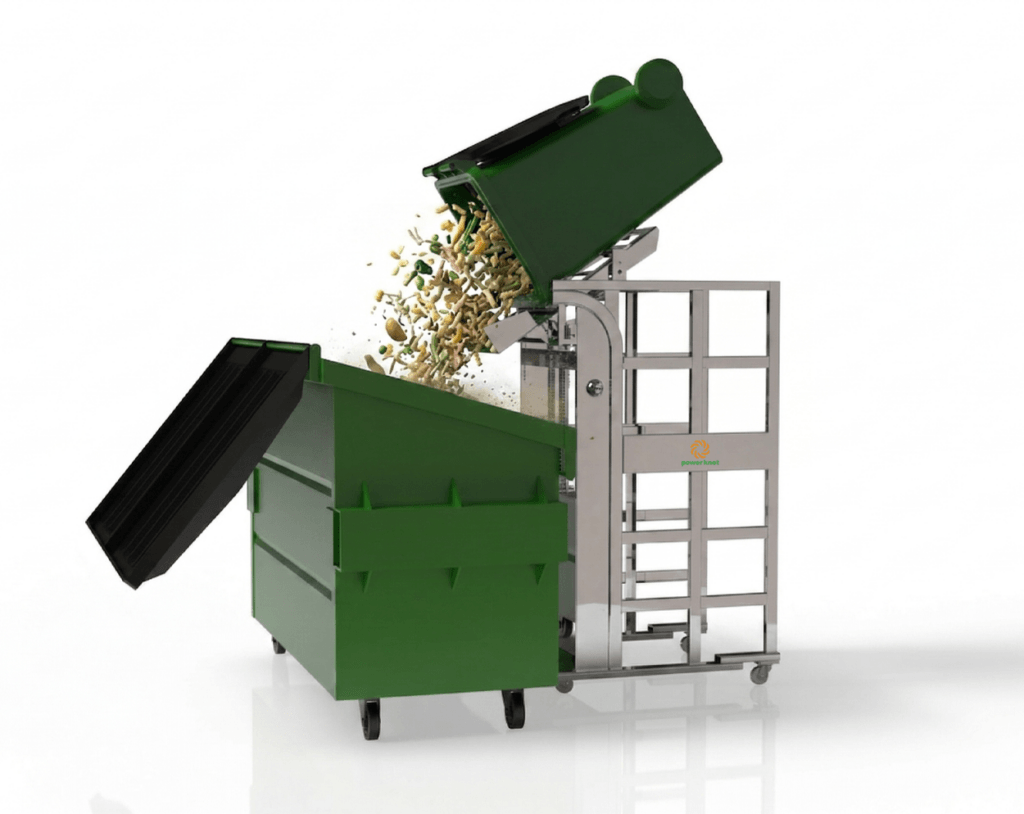
University campuses deal with high waste volumes across dispersed locations: dining halls, research buildings, student accommodation, and administrative facilities. Many have waste diversion targets or composting programs that depend on being able to move large quantities of organic waste reliably and without injury.
In Practice: University of California, Riverside
UCR purchased an SBT bin tipper from Power Knot in 2020 to support its composting program. Dining hall containers weighed up to 200 lb and were being moved manually, creating safety issues and slowing operations. The bin tipper is used to lift containers into a dehydrator and three-yard dumpster. In the first year, the team diverted over 200 tons of food waste from landfill to compost.
Gustavo Plascencia, General Manager of Special Projects at UCR: “We highly depend on the SBT bin tipper for the success of our composting program.”
Tribal and Casino Operations
Casino resorts and tribal facilities generate continuous waste across buffet lines, food service outlets, and event spaces. The pace of service means bins fill quickly and need emptying without disrupting operations. Many tribal operators also have formal environmental stewardship commitments that extend to how waste is managed on their land.
A bin tipper allows waste to be moved quickly and safely from the point of generation to composting, biodigestion, or disposal, without requiring staff to lift full containers throughout their shift.
In Practice: Gun Lake Casino, Wayland, Michigan
Gun Lake Casino is owned and operated by the Match-E-Be-Nash-She-Wish Band of Pottawatomi Indians, a federally recognized Michigan tribe. The casino’s Harvest Buffet generates food waste that was originally going directly to landfill. The tribe had an in-house bin tipper, but it was stationary and not suited to moving waste from the buffet to the backroom biodigester. In 2022, they purchased the SBT bin tipper to bridge that gap. By diverting organic waste from the general trash, the tribe reduced the weight of waste hauled by external contractors, eliminated odors from the compactor, and cut the labor previously needed to segregate waste after the fact.
Shawn McKenney, Environmental Specialist at Gun Lake Tribe Environmental Department: “From day one, the SBT bin tipper helps us safely and effectively transport food waste from the Harvest Buffet to the biodigester. It is lightweight, mobile, and has helped process over 1600 lb of food waste.”
Choosing the Right Model
The SBT-140 bin tipper handles bins up to 140 litres (35 gallons) and loads up to 50 kg (110 lb). It fits through standard doorways and is well suited to environments where mobility and hygiene take priority. The SBT-360 bin tipper handles bins from 90 to 360 litres (24 to 96 gallons) and loads up to 140 kg (300 lb), with remote control operation and a compact footprint suited to trucks and high-volume industrial settings.
Both models are stainless steel, battery-powered, require dual-hand operation, and have a design life of 15 to 25 years. Contact Power Knot today to learn which model works for your industry and unique business needs.