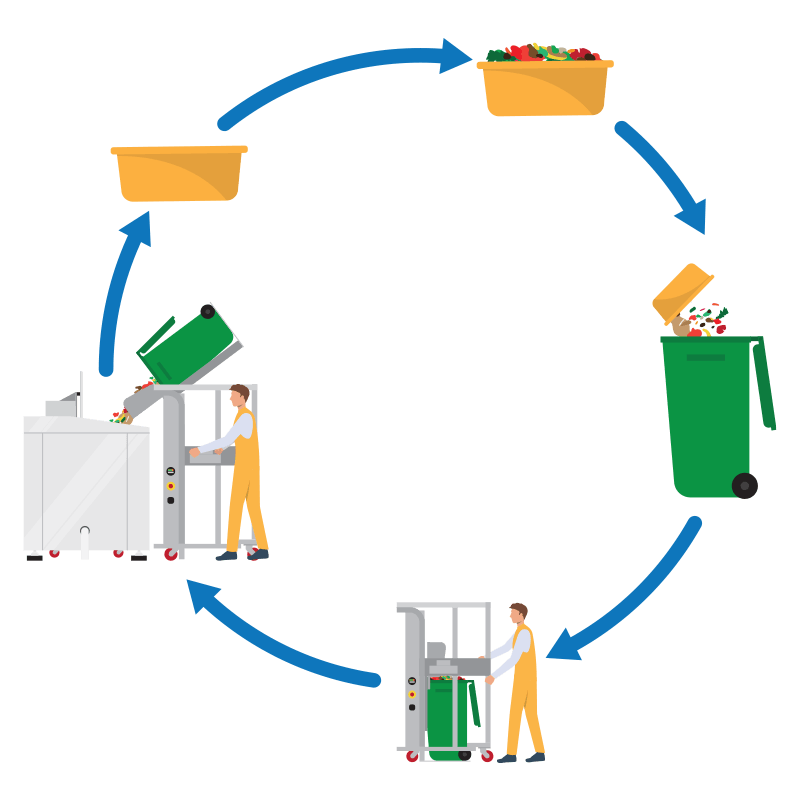

Most discussions about bin tippers begin with safety. That’s important, but it is not the full story.
The more meaningful perspective is operational.
In facilities that generate consistent waste such as food production, manufacturing, and commercial kitchens, manual bin handling is one of the most reliable sources of workflow delay. It happens repeatedly across every station, every shift, and every team.
A bin tipper is not just a safety device. It is a workflow engineering tool. The SBT bin tipper from Power Knot eliminates specific, identifiable bottlenecks at predictable points in a working shift. The following discussion walks through those points and what they cost in time and labor.
- Mid-Prep Bin Changes
Waste accumulates quickly during intensive preparation. When a bin fills mid-prep, the person at that station has two options: stop work, lift the bin, carry it to the disposal point, and return; or keep working and let it overflow. Neither is acceptable. Stopping breaks concentration and rhythm. Overflow creates contamination risk, floor hazards, and a larger cleanup later.
The underlying problem is that manual bin emptying requires the person generating the waste to also manage its removal. The value-adding work stops while the worker handles a logistics task that should be automated.
Every mid-prep bin change takes two to five minutes. Across multiple prep stations and a full prep shift, those interruptions add up to a significant and unrecoverable block of labor time.
According to research from Aberdeen Strategy & Research, average manufacturing downtime costs $260,000 per hour. That’s roughly $4334 per minute.
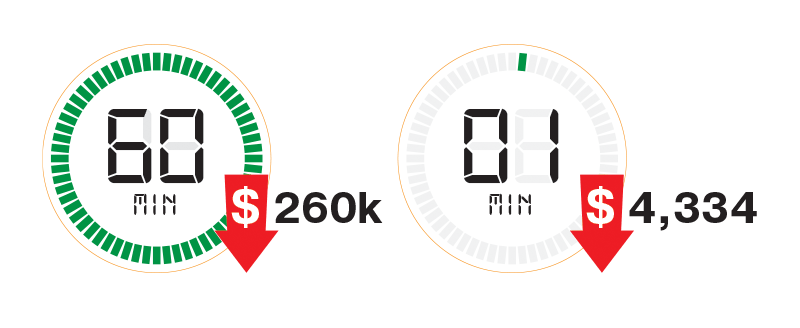
A SBT-140 bin tipper positioned near the prep station reduces downtime. The tipping cycle completes in under 20 seconds and the staff member returns to work immediately. The interruption shrinks from minutes to seconds, and the physical effort of lifting a bin weighing 35 kg or more is eliminated.
- Mid-Service Bin Changes
Service periods are when waste builds up fastest and when overflow causes the greatest disruption. At that point, every staff member is already committed to a role. If a bin fills, someone must either leave their station to deal with it or leave it in place while the problem worsens. Either choice slows the station, affects nearby staff, and creates delays that are difficult to recover during peak demand.
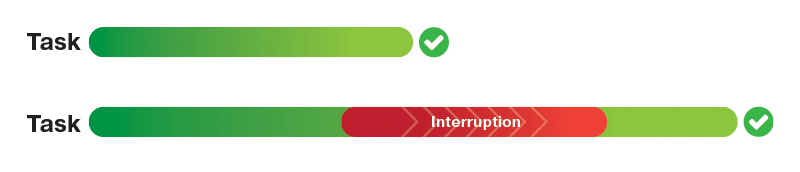
Waste accumulation does not follow the schedule of service. An operation relying on manual handling has no reliable way to empty a bin during peak demand without pulling a staff member away from productive work. Research in interruption science consistently finds that task completion time extends by around 50% when workers are pulled off a primary task and required to return to it.
A battery-powered, mobile bin tipper changes this. It requires no fixed power connection, fits through standard doorways, and can be positioned at the point of waste generation. Waste is tipped during service without the staff member leaving their station for more than a few seconds.
- End-of-Shift Consolidation
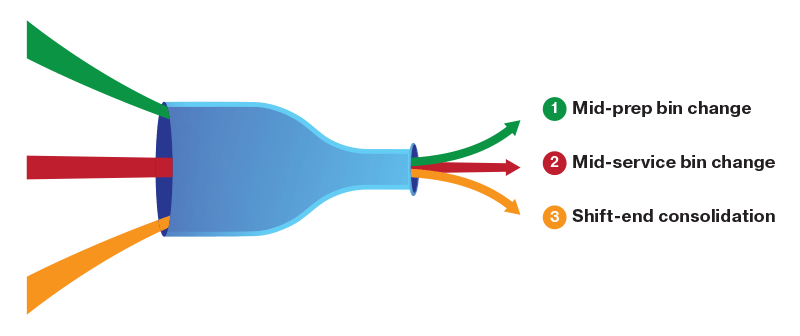
When service ends, bins from every station need to be emptied and consolidated. In large operations, this means multiple staff members moving multiple heavy bins across the full facility footprint, at the end of a long and physically demanding shift. This is the highest-risk point for handling injuries: bins are at their heaviest and staff are at their most fatigued.
It is also the slowest part of the day. Multiple trips, long carry distances, and the pressure to close down quickly before the next shift all converge at the same time.
The SBT-360 bin tipper, with a capacity for bins up to 360 litres and loads up to 140 kg (300 lb), handles this well. Its remote control operation allows tipping without the operator standing directly adjacent to the machine, useful when emptying into compactors or elevated containers. One mobile unit can service multiple consolidation points in sequence.
The Carry Distance Problem
All three bottlenecks share the same structural problem: waste disposal points are usually located away from where waste is generated. Every full bin must be carried, rolled, or moved across the facility before it can be emptied. In large sites, that distance may be 20, 30, or 50 meters or more.
Each trip is a non-productive time. Multiply that by the number of bins, the number of staff involved, and the number of shifts per week, and that carry distance becomes a measurable and ongoing labor cost.
A mobile bin tipper reduces this by being positioned close to the point of waste generation, not at a fixed disposal location. Staff bring the bin to the nearest tipper. The carry distance shrinks, the time per cycle drops, and the labor cost falls accordingly.
Making the Calculation
Quantifying the gain from a bin tipper starts with a basic audit:
- How many times per shift is each bin emptied, at each station?
- How long does each cycle take, including carry time, lifting, disposal, and return?
- How many staff members are involved in waste handling across the shift?
- How many times does a bin overflow or disrupt service?
In busy operations, conservative estimates often place manual bin handling at 20 to 40 minutes of labor per staff member per shift. In a facility with five staff across two shifts, that adds up to three to seven hours of labor every day spent on a task that a bin tipper can reduce to a fraction of the time.
That labor is not eliminated. It is redirected to preparation, service, and the work that actually drives the operation.
Engineering the Workflow
The most useful framing for a bin tipper investment is not safety compliance, though it delivers that too. It is a workflow engineering decision: identifying a recurring, predictable source of delay and replacing it with a faster, more reliable process.
In the case of a food processing center or manufacturing facility; when paired with the LFC biodigester, the bin tipper closes the loop entirely. Food waste moves directly from the workstation bin into the biodigester via the tipper, without bags, without carry trips, and without interrupting the work that matters.
Power Knot can help you identify exactly where manual bin handling is costing your operation time and labor. Contact Power Knot today to discuss your facility layout, waste volumes, and shift patterns.